Written by Kile Stumbo, Field Crew Leader.
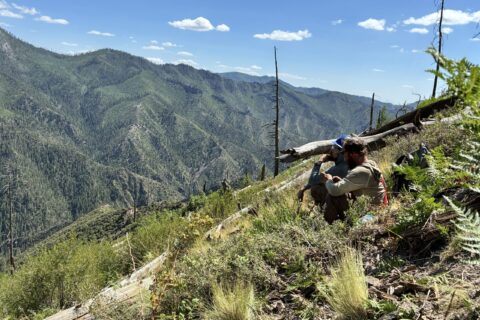
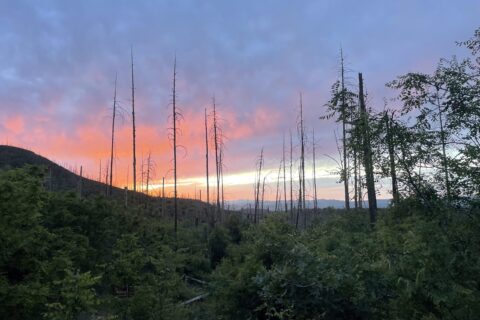
Last week our field crew drove to a remote part of the Apache-Sitgreaves National Forest to work on McBride Mesa Trail #25, part of the larger Eagle National Recreation Trail. This trail and many others in the area have large segments that are highly eroded or almost untraceable due to effects from the large Bear Wallow Fire fifteen years ago.

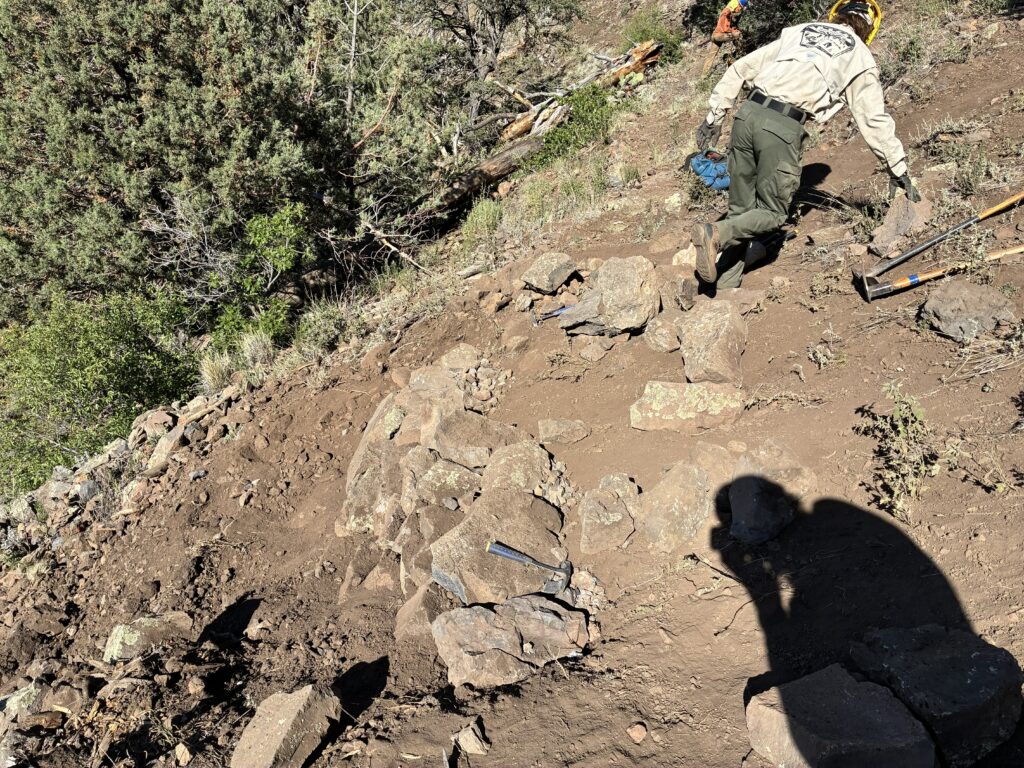
After meeting up with Alex from the Forest Service, we set up camp near the trailhead and scouted the first mile of the trail. Over the next two days, we worked in two groups: one group brushing and treaded the upper section of McBride, while the others worked as a chainsaw team cutting logs out of the trail corridor, before transitioning to rockwork: building 3 rock retaining walls to help protect freshly re-treaded trail from eroding and guide hikers across rough, rocky portions of the slope.
While work continued on McBride Mesa trail, Sam Baggenstos, our Conservation & Wilderness Associate, took a couple days to scout the very faint and sometimes non-existent Bear Spring Trail, designing two reroute proposals to potentially move the trail up out of the flood zone in the future. Much of the original Bear Spring route sustained large amounts of erosion after the Bear Wallow Fire, which led to many sections getting fully washed out during seasonal flooding. The reroutes would help to increase the longevity of the trail by climbing up out of the flood zone, minimizing seasonal erosion.
After a long day of scouting, treading, and brushing, the crew once again celebrated Bean Friday with Jonathan’s time-honored crunch wrap dinner, a welcome delicious meal after a hard day’s work.

By the end of our hitch, our crew re-treaded and brushed 1.51 miles of trail, built 3 retaining walls, 2 cairns, and cut/moved 81 logs out of the trail corridor from the top down to the junction with the Highline Trail #47.

We were glad to have Sam back with us after a few months leave where he was living and working in Georgia. At the same time, we were also heartbroken to lose three of our crew, Eric, Foster, and Sage, due to budget constraints brought on by the increasingly challenging funding climate facing conservation nonprofits.
The important work Wild Arizona and the U.S. Forest Service accomplish together only happens due to the skilled people that make it happen. These people deserve to be paid for their hard work. When funding and staff are cut, the state of our public lands is put in jeopardy. So please donate if you can to help support the conservation of public lands, and contact your political representatives to tell them why public lands are important to you, and why we need to fund the agencies that manage and protect them.